Electrical insulators are essential components in power transmission and distribution systems. Whether used in overhead transmission lines, substations or high-voltage electrical equipment, they must maintain reliable insulation under different electrical stresses.
For insulator manufacturers, passing visual and mechanical inspections is not enough. Electrical withstand tests are also necessary to evaluate insulation performance and verify whether a product meets its design and applicable standards.
Among the high-voltage tests used in insulator development and manufacturing, DC withstand testing, lightning impulse voltage testing and impulse current testing serve different purposes.
Understanding these differences helps manufacturers select the right test equipment and establish an effective testing program.
1. Why Are Electrical Withstand Tests Important for Insulators?
Insulators are exposed to different electrical stresses during operation. These may include continuous operating voltage, temporary overvoltage and transient overvoltage caused by lightning or switching events.
A defect in the insulating material, an interface problem or inadequate electrical design may lead to insulation failure under these conditions.
Electrical withstand testing helps manufacturers and testing laboratories:
Verify the electrical insulation performance of a product.
Evaluate its ability to withstand specified voltage stresses.
Identify potential insulation weaknesses during product development.
Support design verification and type testing.
Provide test evidence for product quality assessment.
Different tests simulate different electrical conditions. Therefore, the test method should be selected according to the insulator design, application and relevant product standard.
2. DC Withstand Voltage Test for Insulators
A DC withstand test evaluates an insulator's ability to withstand a specified direct voltage for a defined period without unacceptable insulation failure.
During the test, a controlled DC voltage is applied between the relevant electrodes or conductive fittings of the insulator. The voltage is gradually raised to the specified level and maintained for the required duration.
The test team monitors the voltage, leakage current and any abnormal discharge or breakdown.
Typical test objectives include:
Evaluating insulation performance under DC electrical stress.
Checking for potential insulation defects.
Verifying product design against specified DC test requirements.
A high-voltage DC generator is used to provide the required test voltage. Its output voltage range, current capacity, ripple performance and measurement accuracy should be matched to the test object and procedure.
It is important to note that DC withstand testing is not a universal requirement for every AC insulator. Its application depends on the insulator type, DC system requirements and applicable testing standard.
3. Lightning Impulse Voltage Withstand Test
In actual power systems, lightning can introduce steep-front transient overvoltages into transmission lines and substations. Insulators must withstand these short-duration voltage stresses without disruptive discharge or puncture, as required by their design and test specification.
A lightning impulse voltage test simulates this electrical condition in a controlled laboratory environment.
The impulse generator produces a high-voltage waveform with a specified peak value and wave shape. The voltage is applied to the insulator under the prescribed test arrangement, and the test team observes its response.
Key factors include:
Peak voltage: The specified impulse voltage level.
Wave shape: The required front time and time to half-value.
Polarity: Positive or negative impulse, as required by the test procedure.
Test sequence: The specified number of applications and evaluation criteria.
For conventional full lightning impulse testing, the commonly used standard waveform is 1.2/50 μs. However, the actual waveform and test sequence must follow the applicable product standard.
A lightning impulse voltage generator is therefore an important piece of equipment for insulator manufacturers and high-voltage testing laboratories conducting insulation design and type tests.
4. Impulse Current Withstand Testing
Impulse current testing is different from impulse voltage testing. Instead of applying a specified voltage waveform, the test system delivers a controlled current impulse through the designated test circuit.
Where required by the product specification, impulse current testing can be used to evaluate the ability of relevant insulator assemblies, conductive fittings or associated components to withstand specified transient current stresses.
Depending on the test objective, engineers may evaluate:
Peak impulse current.
Current waveform and duration.
Thermal and electrodynamic effects.
Physical damage or changes after testing.
The test circuit and measuring system must be designed to deliver and record the specified current waveform reliably.
An impulse current generator is used for this purpose. The required current peak, waveform, energy and repetition sequence should be determined from the relevant test specification.
An important distinction: Impulse current testing is not a universal replacement for lightning impulse voltage testing. The two methods evaluate different electrical stresses and should only be included when required by the relevant product or project specification.
5. High-Voltage Test Equipment for Insulator Testing
Different withstand tests require different high-voltage sources. Selecting the right equipment starts with identifying the test method and its electrical requirements.
SUTE provides several types of high-voltage testing equipment that can be used for insulator withstand and type testing.

High-Voltage DC Generator
Provides a controlled DC high-voltage output for insulator DC withstand testing and other specified DC dielectric tests.
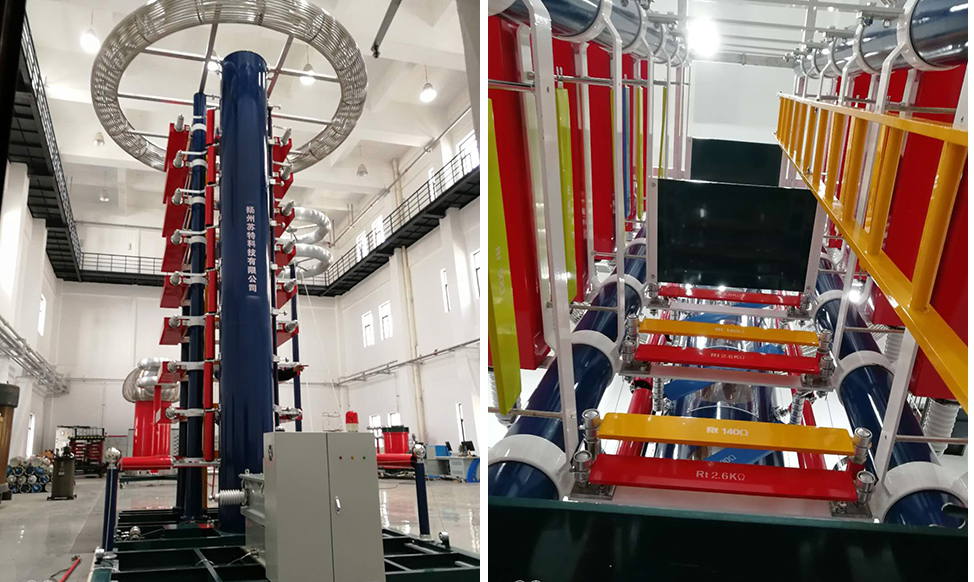
Impulse Voltage Generator
Generates specified high-voltage impulse waveforms for lightning impulse withstand testing of insulators and other high-voltage electrical equipment.

Impulse Current Generator
Supplies controlled high-current impulses for specified impulse current withstand tests on insulator assemblies and related electrical components.
The equipment configuration depends on the required voltage or current level, waveform, test object dimensions, electrode arrangement and measurement requirements.
For manufacturers conducting multiple types of electrical tests, these systems can be selected individually or considered as part of a broader high-voltage testing laboratory.
6. Relevant Testing Standards
The applicable standards depend on the material, construction and intended application of the insulator. The following IEC standards provide useful references for insulator testing and high-voltage test techniques.
Standard |
Main scope |
|---|---|
IEC 60383-1:2023 |
Ceramic or glass insulator units for AC overhead lines: definitions, test methods and acceptance criteria |
IEC 61109:2025 |
Composite suspension and tension insulators for overhead lines |
IEC 62217:2025 |
General definitions, test methods and acceptance criteria for polymeric HV insulators |
IEC 60060-1:2025 |
General terminology and test requirements for DC, AC and impulse voltage tests |
IEC 62475:2026 |
High-current test techniques, including impulse-current measurement requirements |
These standards serve different purposes. IEC 60383-1, IEC 61109 and IEC 62217 address specific insulator product families, while IEC 60060-1 provides general requirements for high-voltage dielectric testing. IEC 62475 addresses high-current testing and measurement techniques.
Not every test listed in these standards applies to every insulator. Manufacturers should identify the relevant product standard and confirm the required test sequence, voltage or current level, waveform and acceptance criteria before conducting the test.
7. How to Select the Right Test System
When planning an insulator testing project, selecting equipment based only on its maximum output voltage or current is not sufficient.
Engineers should first clarify the following information:
Selection factor |
Information required |
|---|---|
Insulator type |
Ceramic, glass or composite |
Test method |
DC withstand, lightning impulse voltage or impulse current |
Required output |
Voltage or current peak |
Waveform |
Required impulse shape and tolerance |
Test arrangement |
Electrode configuration and test connections |
Test procedure |
Application sequence and acceptance criteria |
For example, a lightning impulse voltage test requires a generator capable of producing the specified voltage waveform. An impulse current test requires a different circuit design and current measurement arrangement.
A clear understanding of the test objective helps avoid selecting equipment that meets the nominal output rating but does not satisfy the actual testing requirements.
Frequently Asked Questions
What is the difference between an impulse voltage test and an impulse current test?
An impulse voltage test applies a specified transient voltage to evaluate insulation withstand performance. An impulse current test delivers a specified current impulse to evaluate the electrical and thermal withstand capability of the test object or relevant components.
Is DC withstand testing required for all insulators?
No. DC withstand testing is required only when specified by the applicable product standard, system application or project test procedure.
Can one test system perform all three insulator withstand tests?
Generally, these tests require different high-voltage or high-current generating circuits. A laboratory may use separate DC, impulse voltage and impulse current systems, depending on its testing requirements.
Which information should be provided when requesting an insulator test system?
The insulator type, rated voltage, required test method, target voltage or current, waveform, test duration and applicable standard are useful starting points for equipment selection.